
& PORCH DAMAGE
BUFFALO NY
Buffalo’s aging housing stock and relentless moisture cycles make wood rot one of the most common — and most underestimated — problems in WNY homes. What looks like peeling paint on a porch often conceals structural decay that has been spreading silently for years.
Wood rot in WNY homes is almost always moisture-driven — not age alone. Buffalo’s combination of heavy snow, ice dam runoff, freeze-thaw cycles, and high humidity creates persistent wet conditions that accelerate fungal decay in any untreated or poorly maintained wood. The damage is invisible until it’s expensive.
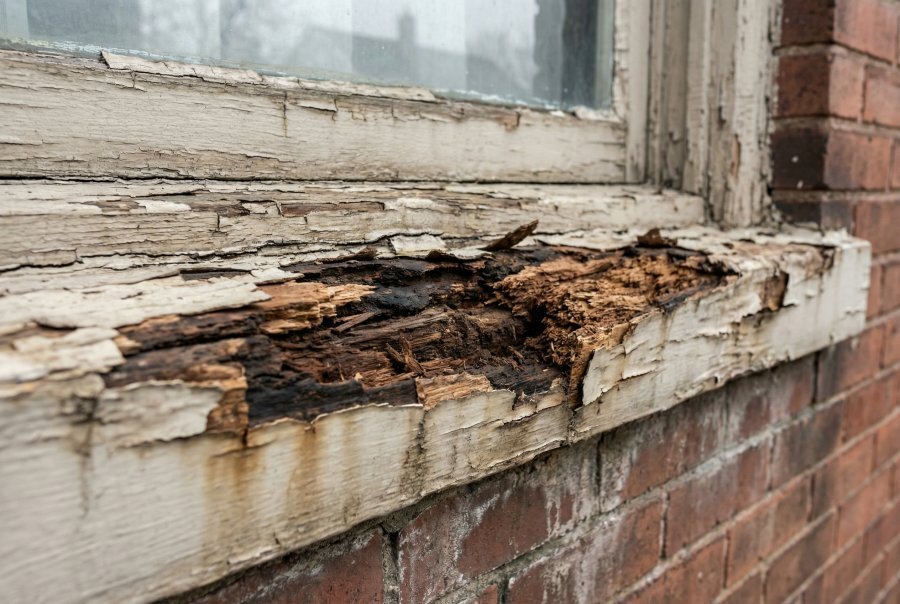
Horizontal sills collect water from every rain event. In WNY’s older wood-frame homes, sill rot typically starts at the end grain where caulking has failed, spreads inward along the sill, and eventually reaches the rough framing below. A sill that feels solid from outside can be completely hollow inside.
$300 – $2,500 per sill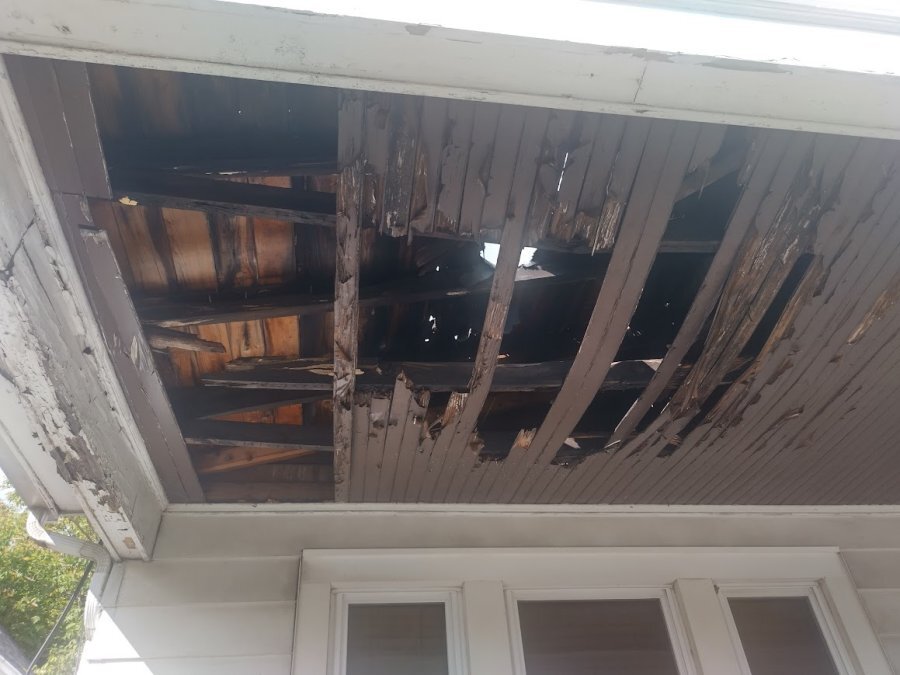
Porch decks on pre-1970 Buffalo homes are typically untreated dimensional lumber that has been wet and dried hundreds of times. Deck boards rot from below — the underside stays damp while the top surface appears weathered but intact. When deck framing joists rot at the ledger connection, the entire porch can become unsafe.
$3,000 – $18,000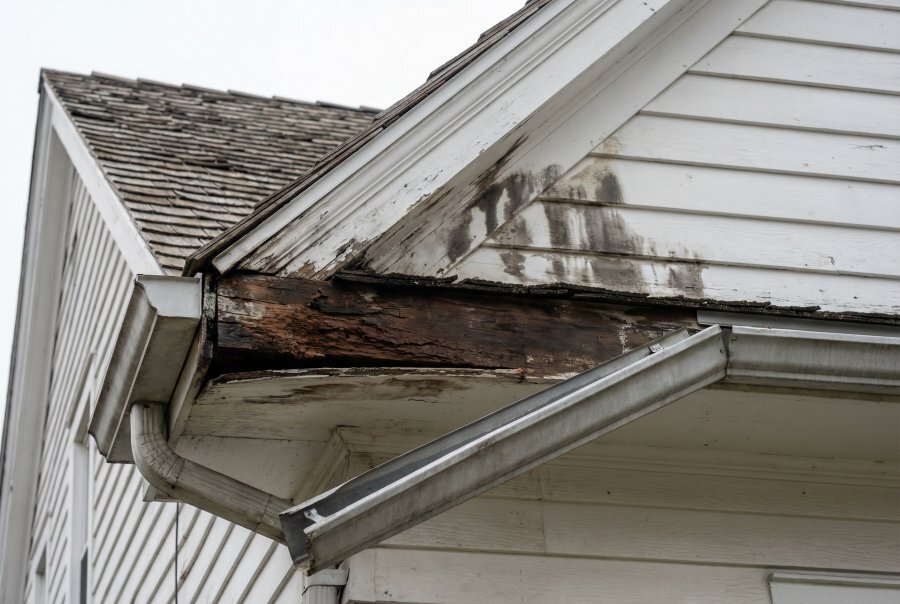
Fascia boards (the flat boards behind gutters) and soffits (the underside of the roof overhang) are the first exterior wood to fail when gutters overflow or flashing fails. Ice dam runoff is the primary cause in WNY. Rotted fascia compromises gutter attachment and allows water entry into the wall cavity above.
$800 – $5,000The sill plate sits directly on the foundation and is the lowest piece of structural wood in the entire house. In WNY homes with basement moisture problems, the sill plate and band joist (the perimeter joist sitting on the sill) are frequently rotted or termite-damaged — a finding that alarms buyers and lenders alike.
$2,000 – $12,000Original wood clapboard siding on older Buffalo city homes rots where paint has failed and moisture has penetrated. Corner boards — the vertical trim pieces at building corners — collect water at lapped joints and rot from the bottom up. Often the first visible sign that larger problems exist behind the wall surface.
$1,500 – $8,000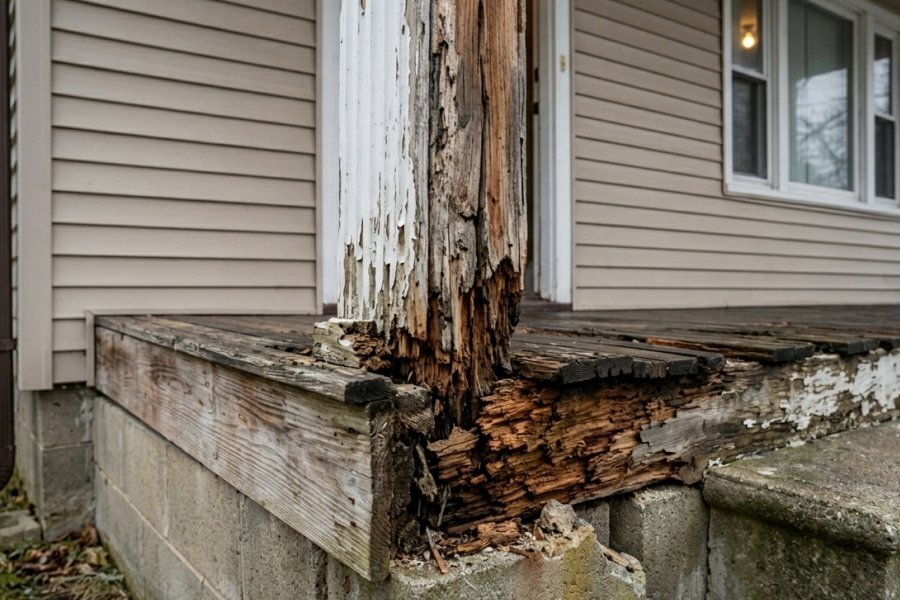
Porch posts rot at the base where they meet the deck or porch floor — the most moisture-exposed point. A post that looks structurally sound above deck level can be completely hollow at grade. Rotted porch posts are a safety hazard and a guaranteed red flag in any buyer’s inspection in Western New York.
$400 – $2,500 per post⚠ The invisible spread rule: Wood rot caused by fungal decay spreads to adjacent wood as long as moisture is present. By the time you see surface deterioration, the rot has already extended 6–12 inches beyond the visible damage in every direction. Always probe and inspect the full surrounding area before accepting any single-item repair quote.
The most reliable field test for wood rot requires nothing more than a flathead screwdriver. A firm probe into healthy wood leaves only a small indentation. Rotted wood gives way easily, feels spongy, and the screwdriver sinks in with little resistance. Work methodically through these 8 locations on any WNY home:
Both ends of every sill. End grain absorbs moisture fastest. Rot here before the face shows any sign.
At and just below deck level. Often hollow inside while appearing solid on the surface.
Where gutters attach. Overflow and ice dam runoff concentrate here. Probe along full length.
Outer edge boards and ledger connection at house. Perimeter stays wettest longest.
Access from basement. Probe along full perimeter where wood meets concrete foundation.
Rot travels up from grade. Bottom of corner boards almost always fails first in WNY homes.
Exterior door frames rot at the bottom corners. Check both sides of every exterior door.
Where soffit meets fascia. Ice dam runoff saturates this junction every winter in WNY.
ⓘ Buffalo-specific timing: Spring is the best time to assess wood rot in WNY — after winter moisture has done its work and before summer drying conceals active decay. If you’re considering selling, a spring assessment gives you the full picture before listing season.
Wood rot repair costs in WNY scale rapidly once the scope expands beyond surface-level damage. The table below reflects real Erie County contractor pricing. Always address the moisture source before any repair — otherwise the rot returns within 2–3 years.
| Repair Type | WNY Cost Range | Priority | Notes |
|---|---|---|---|
| Window sill replacement (per sill) | $300 – $1,200 | Address soon | Wood or composite replacement. Address flashing/caulking to prevent recurrence. |
| Porch deck boards replacement | $1,500 – $6,000 | Address soon | Composite decking recommended for WNY moisture conditions. |
| Full porch rebuild (deck + framing) | $8,000 – $22,000 | Urgent | When framing joists and ledger are compromised. Common in pre-1960 WNY homes. |
| Fascia & soffit replacement | $800 – $4,000 | Address soon | Full perimeter run. Aluminum or PVC wrap most durable in WNY climate. |
| Sill plate & band joist repair | $2,500 – $12,000 | Urgent | Requires temporary shoring. Fix basement moisture source first or rot returns. |
| Porch post replacement (per post) | $400 – $1,800 | Urgent | Load-bearing — do not delay. Fiberglass or composite posts last longest in WNY. |
| Wood siding & corner board replacement | $2,000 – $10,000 | Address soon | Per wall section. Consider vinyl or fiber cement upgrade for long-term durability. |
| Epoxy consolidant fill (minor rot) | $200 – $800 | Monitor | Only viable for surface rot without structural compromise. Temporary solution. |
ⓘ The scope creep problem: Wood rot repairs rarely stay within the original estimate. A porch deck replacement commonly reveals rotted ledger boards, compromised joist hangers, and deteriorated sill framing — tripling the original scope. Budget for 150–200% of the initial quote when planning wood rot remediation in older WNY homes.
Can I sell a Buffalo house with wood rot and porch damage?
Yes — but wood rot and structural porch damage must be disclosed on New York’s Property Condition Disclosure Statement. With disclosure, mortgage lenders typically require repairs before loan approval, especially for FHA and VA loans where appraisers are required to flag structural deficiencies including rotted framing and unsafe porches. Nickel City Buyers purchases homes with wood rot, porch damage, and exterior deterioration across all of Erie and Niagara County — no repairs required before closing.
How much does it cost to replace a rotted porch in Buffalo NY?
A basic porch deck board replacement runs $1,500–$6,000 for a typical WNY front porch. When the underlying framing, ledger board, and posts are also compromised — which is common in pre-1960 Buffalo homes — a full porch rebuild runs $8,000–$22,000. Always budget for scope creep: rot repairs in older WNY homes routinely expand to 150–200% of the original estimate once framing is exposed. Get 3+ quotes from licensed Erie County contractors.
What causes wood rot in Buffalo NY homes?
Moisture is the root cause in every case — fungal decay requires sustained wet conditions to establish and spread. In WNY, the primary moisture sources driving wood rot are: ice dam runoff saturating fascia and soffits, gutter overflow soaking porch framing and sills, basement moisture wicking into sill plates and band joists, failed caulking and flashing allowing water into wall framing, and accumulated snowmelt pooling at porch bases. Buffalo’s freeze-thaw climate keeps wood wet longer than almost any other region, accelerating decay year-round.
How do I know if my porch is structurally unsafe in Buffalo?
Key warning signs of structural porch failure in WNY homes: visible bounce or flex when walking the deck, soft spots underfoot, porch posts that rock or shift, visible gaps where the ledger board meets the house, porch pulling away from the house at the connection point, visible rot at post bases, or deck boards that sink or crack when weight is applied. If you observe any of these, treat the porch as potentially unsafe and get a structural assessment before using it.
Does wood rot affect home value in Buffalo NY?
Yes — significantly. Wood rot is a visible defect that appraisers flag and buyers negotiate hard on. Exterior rot visible at the street level — peeling paint, rotted fascia, deteriorated porch — reduces perceived value before a buyer ever steps inside. Structural rot discovered in inspection routinely triggers repair demands of 150–200% of actual repair cost, or complete deal cancellation. In Buffalo’s competitive cash buyer market, sellers with rot issues often find that NCB’s as-is offer nets more than the repair-and-retail path after all costs are counted.
Can NCB buy my Buffalo home if it has extensive wood rot and porch damage?
Yes — wood rot at any location and any severity does not disqualify a property. We’ve purchased WNY homes with rotted sill plates, collapsed porch framing, deteriorated fascia, and full exterior wood failure. We factor all known conditions into our as-is cash offer. See our Buffalo Construction Problems Resource Center or call (716) 557-7005 for a free no-obligation assessment.
Nickel City Buyers — Buying Homes With Wood Rot & Porch Damage Across WNY Since 2013
Nickel City Buyers, LLC purchases homes with wood rot, porch damage, sill plate failure, fascia deterioration, and exterior structural defects throughout Erie County and Niagara County, New York. Address: 3842 Harlem Rd STE 400-339, Cheektowaga, NY 14215. Phone: (716) 557-7005. Website: nickelcitybuyers.com.
Serving Buffalo, Cheektowaga, Tonawanda, Amherst, Lackawanna, West Seneca, Hamburg, Orchard Park, Lancaster, Depew, Kenmore, Williamsville, East Aurora, Clarence, Akron, Colden, Niagara Falls, Lockport, North Tonawanda, Newfane, and Pendleton. No repairs required. Cash. Close in 7 days. See our as-is buying page →
PORCH DAMAGE.
WE BUY IT ANYWAY.
No porch repairs required. No sill plate replacement. Cash offer within 24 hours. Close in 7 days anywhere in Western New York.