
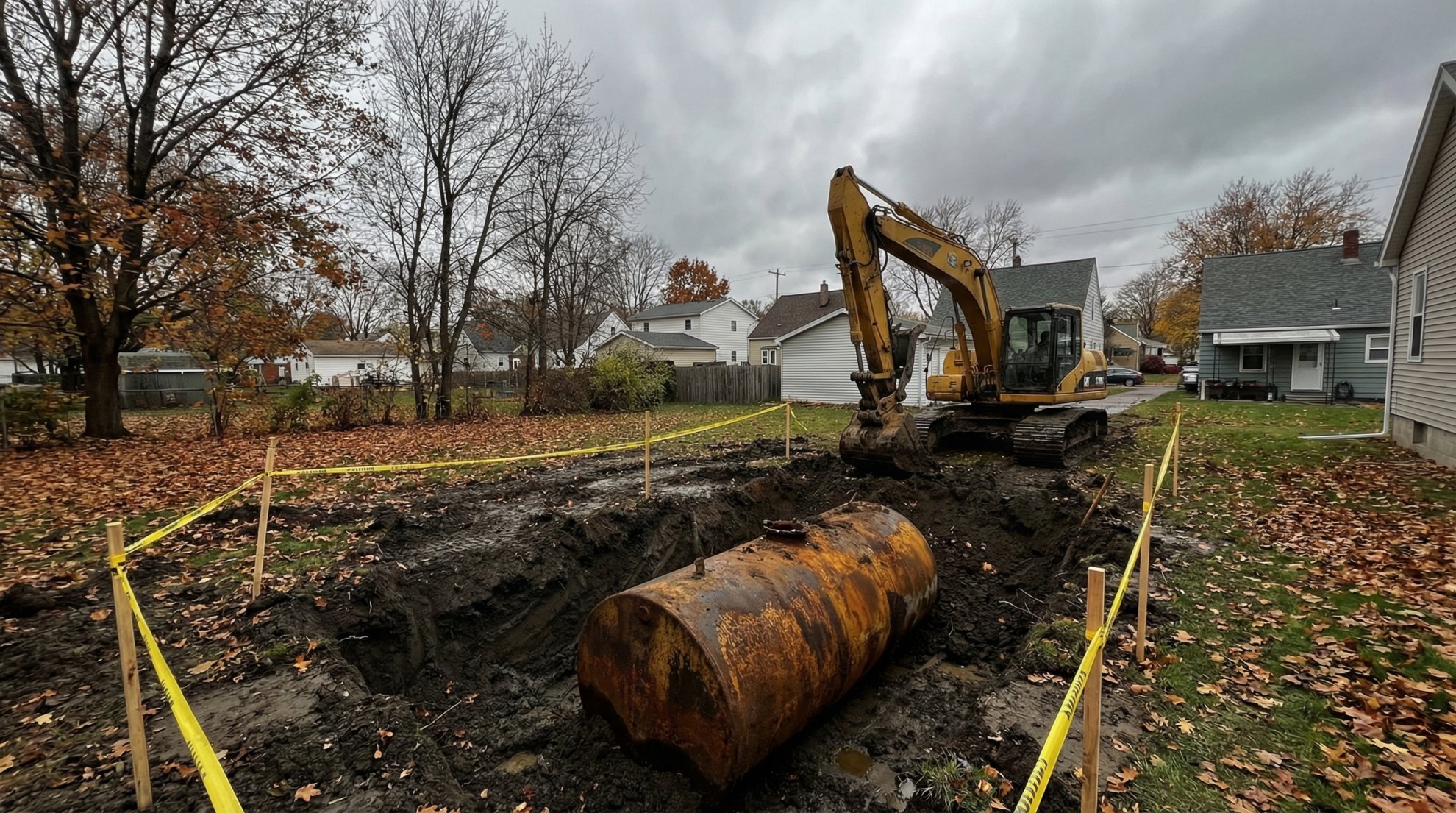
Oil Tank RemovalBuffalo NY
You probably didn’t know what that bathtub-looking thing in the basement was the first time you saw it. A lot of Buffalo homeowners don’t — until someone tells them it used to heat the house, it might be leaking, and it could be the reason the bank won’t approve a buyer’s mortgage.
This is the complete guide to oil tank removal in Buffalo and Erie County — costs, permits, NYSDEC requirements, what to do if it’s leaking, and what happens if you can’t afford the removal and need to sell.
How Much Does Oil Tank Removal Cost in Buffalo NY?
Oil tank removal in Buffalo NY costs $600 to $1,500 for above-ground and basement tanks and $1,500 to $3,000 for underground tanks. Tanks buried beneath a basement floor run higher, commonly $2,000 to $3,500 or more. Add $50–$200 for the municipal permit. If soil testing finds contamination, remediation adds $5,000 to $20,000 or more. Most homeowner’s insurance policies have a pollution exclusion clause that does not cover this. Get multiple quotes from licensed contractors — costs vary significantly based on tank size, location, and access. See the full cost breakdown →
Jump to a section
| WNY Context | Cost Guide | Permits & Rules | Remove vs. Abandon |
| Leaking Tank | Selling Your Home | The Process | FAQ |
|
Why This Matters in Buffalo
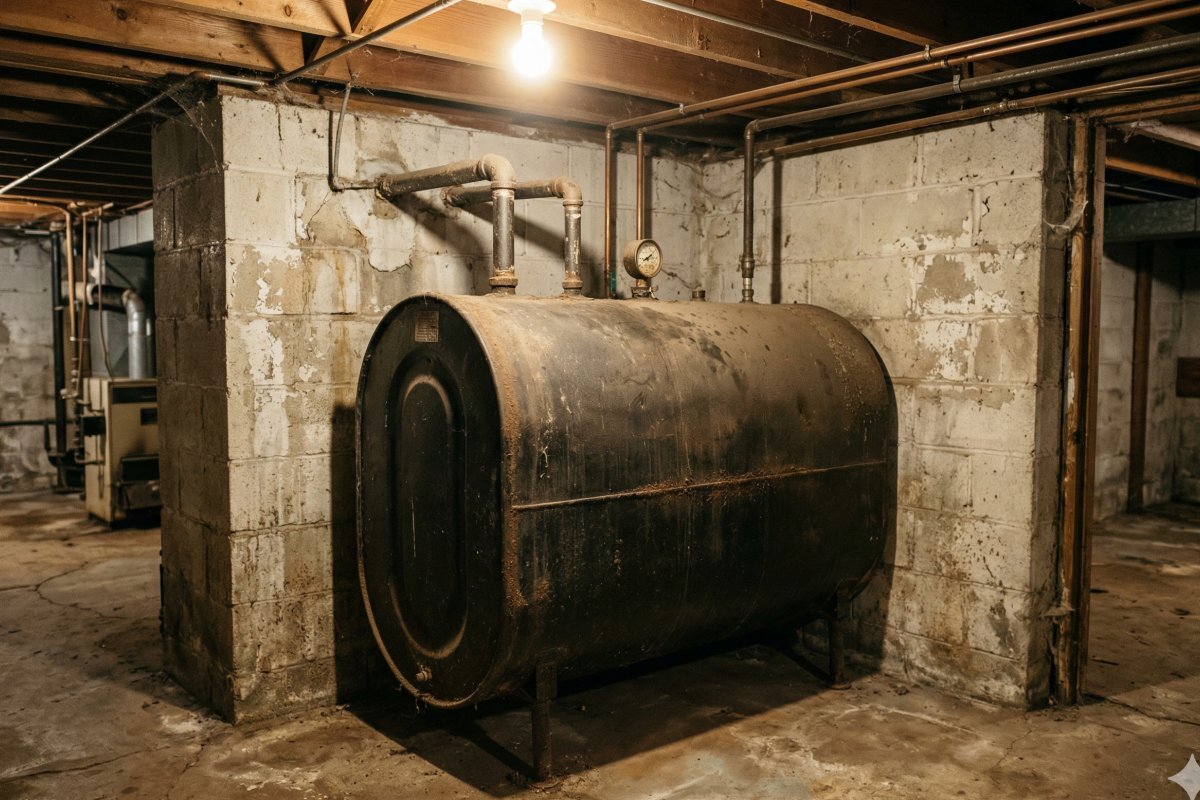
That Bathtub-Shaped Thing in the Basement Has a Story
Before natural gas became the standard in Western New York, most Buffalo homes ran on fuel oil — and that oil had to live somewhere. For decades the answer was a 275-gallon steel tank, usually in the basement, looking like an oversized bathtub on legs with a pipe going into the wall. Generations of Buffalo homeowners heated their houses with these. Some are still active. Many were left behind when the home converted to gas — disconnected, maybe drained, maybe not, sitting in a basement or buried in the yard. In a city where much of the housing stock is 80 to 100+ years old, running into one of these tanks is common. The problem isn’t the tank existing. The problem is what happens next: a steel tank left in place will eventually corrode. A corroded tank leaks. A leaking tank contaminates soil. Contaminated soil costs tens of thousands to remediate — and most homeowner’s policies specifically exclude it. |
⚠ Most Homeowner’s Insurance Policies Don’t Cover This
Many standard homeowner’s policies contain a pollution exclusion clause that excludes oil tank leaks and soil contamination cleanup. If your tank leaks and you don’t carry a separate oil tank rider or endorsement, remediation — which can exceed $20,000 — comes out of pocket. Check your policy now, before there’s a problem.
Upstate New York generally sees lower oil tank removal costs than downstate, driven by labor rates and less regulatory complexity. Here is what Erie County homeowners typically pay.
|
Underground (UST)
Underground Tank Removal
$1,500–$3,000
Common in older Buffalo neighborhoods. Requires excavation, NYS 811 Dig Safe clearance, soil sampling from the excavation pit, and backfill to grade. All piping removed or capped. Tank hauled to a licensed scrap facility. |
Above-Ground (AST)
Above-Ground / Basement Tank
$600–$1,500
The classic 275-gallon basement tank. Residual oil pumped and disposed, tank cleaned and often cut into sections to clear narrow basement stairs — standard in older Buffalo homes. Lines capped at the wall. No excavation. |
Buried Basement
Basement Buried Tank
$2,000–$3,500+
Some pre-1950s Buffalo homes have tanks buried below the basement floor. The most expensive scenario — interior excavation, limited equipment access, and floor restoration afterward. |
| AST / basement removal | $600–$1.5K |
$600–1,500 |
| UST removal | $1.5K–$3K |
$1,500–3,000 |
| Basement buried tank | $2K–$3.5K+ |
$2,000–3,500+ |
| Municipal permit | $50–200 | |
| Soil contamination | $5K–$20K+ |
$5K–$20K+ |
Ranges reflect typical Erie County and upstate NY contractor pricing and are estimates, not quotes. Actual pricing varies by tank size, depth, access, and site conditions. Get at least three written estimates from licensed contractors before committing.
Municipalities across Erie County require a permit before an oil tank comes out, and the work is expected to be done by a qualified contractor. Requirements differ between the City of Buffalo and the surrounding towns and villages, so confirm the specifics with your own building or fire department before scheduling anything.
Where a tank is a regulated petroleum storage system, closure must follow NYSDEC 6 NYCRR Part 613 — including a closure report summarizing the work, confirmatory soil analysis, and site photographs.
NY State Department of Environmental Conservation, 6 NYCRR Part 613. Many residential heating oil tanks used solely for on-premises consumption fall below the registration thresholds and are not regulated facilities. Whether Part 613 closure requirements apply to your specific tank is a question for NYSDEC Region 9 or your municipality — ask before the work starts.
| Requirement | Details |
| Permit | Required by Erie County municipalities before removal begins. City of Buffalo: contact the Fire Prevention Bureau. Suburban towns and villages: contact your building department. Fees typically $50–$200. |
| Qualified Contractor | Removal involves flammable vapors, confined space, and excavation, and municipalities generally require a licensed and insured contractor working to NYSDEC and OSHA guidance. Be wary of anyone who tells you no permit is needed — an unpermitted removal creates problems on your next sale. |
| NYS 811 Dig Safe | Required before any excavation in New York. The contractor has buried utilities — electric, gas, water, sewer — marked before breaking ground. Non-negotiable for underground tank removal. |
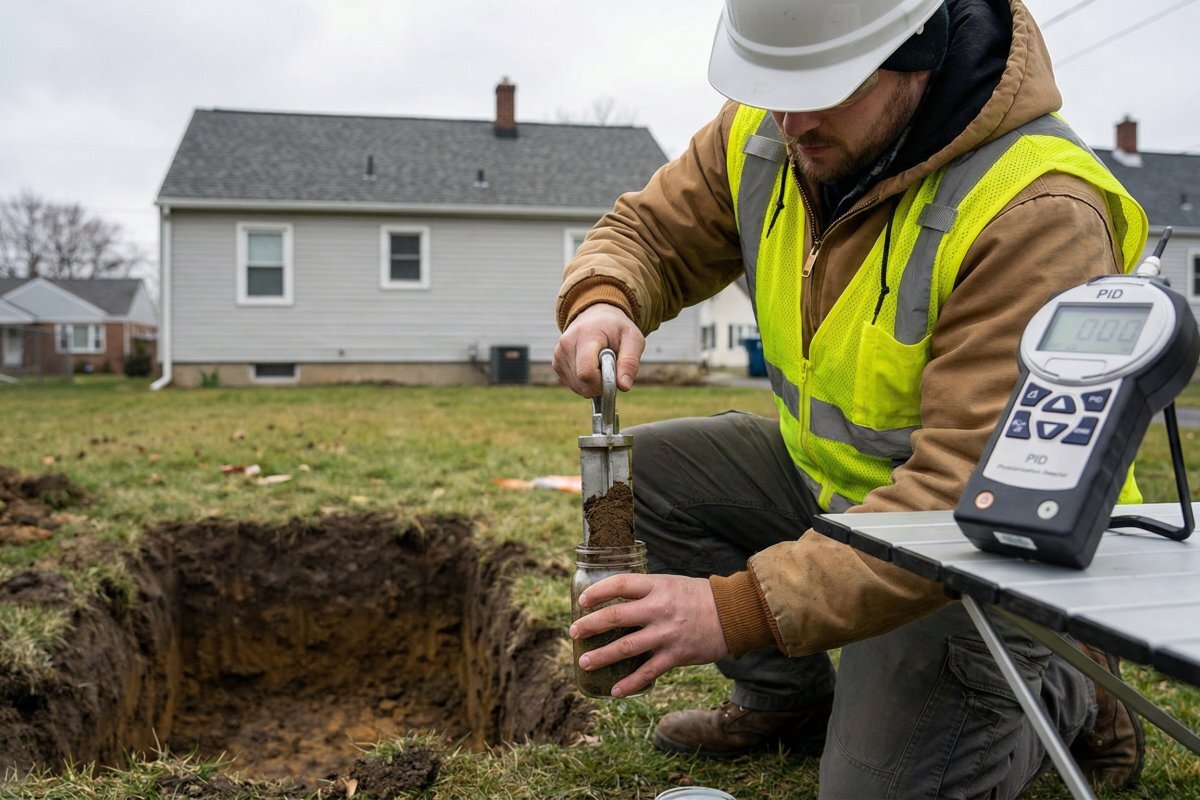
| Soil Testing | Samples collected from the excavation floor and walls, typically two composites, with PID meter screening. Not always mandatory on an unregulated residential tank, but strongly advised — it is the only thing that documents clean soil. Cost roughly $100–$500. |
| Closure Report | A written report from your contractor: work performed, soil analysis results, site photos. Required where Part 613 applies, and worth insisting on either way. Keep it permanently — lenders and buyers will ask for it on any future sale. |
| Spill Reporting | If contamination is discovered, it must be reported to the NYSDEC Spills Hotline at 1-800-457-7362 within two hours of discovery. This applies regardless of tank size. Failure to report is a separate violation. |
Abandonment in place — filling the tank with sand or foam and leaving it where it is — is usually cheaper up front than a full excavation. The question is what you are buying with the savings.
| Factor | Removal | Abandonment in Place |
| Up-front cost | Higher — excavation, hauling, backfill | Typically lower — no excavation |
| Soil condition documented | ✓ Yes — samples taken from the open pit | ✗ Limited — a slow historic leak can go undetected |
| Future contamination risk | ✓ Eliminated — the tank is gone | ✗ Remains — an abandoned tank can still corrode |
| Mortgage approval | ✓ Closure documentation usually satisfies lenders | ✗ Many lenders still require removal |
| Future sale | ✓ Clean — report answers buyer questions | ✗ Buyers and agents often push for removal anyway |
| When it applies | Preferred whenever the tank can be reached | Where the tank sits under a slab, foundation, or structure that can’t be disturbed |
NYSDEC guidance favors removal wherever it is physically possible, because removal is the only path that lets you look at the soil and close the question. Abandonment leaves the tank — and the uncertainty — in the ground. If a leak surfaces later, the cleanup cost lands on top of what you already spent, and it is the seller who usually absorbs it. If you are selling, removal almost always produces the better outcome.
A leaking tank is a different situation from a routine removal. Here is what to do, in order.
NYSDEC Spills Hotline — Report It
If you discover or suspect a leak, New York requires you to report it. Do not wait, do not attempt cleanup yourself, and do not assume it is minor.
Call: 1-800-457-7362 • NYSDEC Spills Hotline • Staffed 24/7
Signs your tank may be leaking:
| Sign | What It Means |
| Unexplained increase in oil use | Often the first indicator — oil disappearing faster than your usage explains |
| Oil smell in the yard or basement | Petroleum odor is distinctive. If you smell it away from the tank itself, investigate immediately |
| Stained or discolored soil | Dark staining above or around the tank indicates contamination |
| Dead grass above the tank | Oil kills vegetation — a dead patch over a buried tank is a red flag |
| Sheen on standing water | An oily sheen in a sump or wet basement area |
If contamination is confirmed, a licensed environmental contractor will characterize the site and develop a remediation plan, with NYSDEC involved. Costs run from around $5,000 for minor contamination to $20,000 or more for a significant spill. If you are facing this and cannot fund remediation, NCB buys properties with oil tank contamination situations →
Can’t Afford Removal?
NCB Buys Buffalo Homes With Oil Tanks. As-Is.
If removal costs more than you can absorb — especially with contamination in the picture — selling as-is may be the better financial outcome. NCB buys Erie County homes with oil tanks in any condition: active, abandoned, or contaminated. Cash offer within 24 hours of walking the property, closing through a licensed Erie County title company. Nothing out of pocket before closing, and closing costs are negotiable. We do charge a commission on our transactions and it is disclosed in writing before you sign anything.
An oil tank — especially an underground one — is a deal-killer on a conventional sale. Here is what you are actually dealing with.
| Party | What They Typically Require |
| Mortgage Lender | Most lenders will not approve a mortgage on a property with an unaddressed underground tank. Even with a permitted abandonment, many still require full removal. That eliminates the majority of conventional buyers. |
| Conventional Buyer | Buyers who can get financing typically require removal before closing, or a price reduction to cover it. Many walk rather than inherit the liability. |
| Home Inspector | Will flag the tank and recommend environmental assessment — which triggers the lender requirement even if the buyer was willing to proceed. |
| Title Company | Will surface any NYSDEC spill record tied to the address. A registered open spill has to be addressed before clean title can convey. |
| NCB (Cash Buyer) | No removal required and no environmental assessment needed before we make an offer. We walk the property, account for the tank in our number, and close through a licensed Erie County title company in 7–14 days. Closing costs are negotiable; commission is charged and disclosed in writing. |
The practical reality: with an underground tank, your realistic buyer pool narrows to cash buyers and investors. NCB is a verified Erie County cash buyer — A+ BBB, 33 five-star Google reviews, 300+ WNY homes purchased since 2013. How to verify any cash buyer before you sign →
 What the Work Actually Looks Like
A typical underground removal in Buffalo runs one day from excavation to backfill, assuming no contamination. Here is the sequence.
01 Permit & PlanningContractor pulls the municipal permit. NYSDEC spill database checked for prior records at the address. NYS 811 called for utility marking. Access and equipment staging planned. |
02 Pump Out Residual OilRemaining fuel oil pumped out with an explosion-proof pump and sludge removed from the tank bottom. Oil disposed at a licensed facility or transferred if still clean. |
03 ExcavationOverburden soil removed to expose the top of the tank, clean spoil set aside for backfill. Basement tanks are cut into sections to clear the doorway instead. |
04 Tank RemovedFill lines, vent lines, and piping disconnected. Tank washed and flushed in place before lifting, then hauled to a licensed scrap metal facility. |
05 Soil TestingComposite samples taken from the excavation floor and walls with PID screening and lab analysis. Results determine whether clean backfill is enough or remediation is needed. |
06 Backfill & RestoreExcavation backfilled with crushed limestone and clean spoil to grade. Topsoil and seed on the surface. Driveway and surrounding area swept clean. |
07 Closure ReportContractor issues the written report: work summary, soil analysis results, site photos. You get a copy. Keep it permanently — it travels with the property. |
08 Final InspectionMost Erie County municipalities require a post-removal inspection confirming lines removed or capped and the area restored. Sign-off closes the permit. |
NCB Buys Buffalo Homes
With Oil Tanks. As-Is.
Underground, above-ground, leaking, or contaminated — NCB has handled it. Cash offer in 24 hours. Close in 7–14 days. A+ BBB since 2013, 300+ WNY homes purchased.
Before you call anyone — check us out. Read our 33 five-star Google reviews, see homes we’ve bought, verify us on BBB.org. We’ve been here since 2013.
Everything connected to this situation.